 SectionHiker.com Backpacking Gear Reviews and FAQs
The Six Moon Designs Lunar Solo is a single-wall trekking pole tent that weighs 26 ounces (740 g). It is a six-sided shelter, shaped like a half pyramid, with a side door and vestibule area that’s good for gear storage or cooking in rainy weather. The single side door is made of mesh for maximum ventilation. The tent is designed to be set up using a single trekking pole, although a 49″ tent pole is also available for purchase. Seam sealing is required but is also available for a nominal fee.
Specs at a Glance
- Weight: 26 oz / 740 g
- Type: Single wall, Trekking pole optional (49″)
- Persons: 1
- Doors: 1
- Vestibules: 1
- Minimum number of stakes to pitch: 6
- Materials:
- Canopy: 20D silpoly
- Floor: 40D silpoly
- Netting: 20D UL noseeum
- Peak height: 48″
- Inner Tent (living space) Dimensions: 90″ x 48″
- Canopy Dimensions: 105″ x 79″
The Six Moons Lunar Solo was the first ultralight backpacking tent I ever bought, about 13 years ago. It’s gone through several design revisions and material changes since, but its key characteristics remain unchanged. It’s also a few ounces lighter weight, despite the fact that the internal volume and living space have increased in the intervening years. This is a review of the most recent version.

The Lunar Solo is a tarp tent with a floating floor attached to its rain canopy with noseeum mesh. The floating floor makes it possible to set up on uneven surfaces and stealth tent sites, while a bathtub floor prevents rain from flooding the inside floor. A single wall shelter, it has one mesh side which functions as a door and provides excellent ventilation in order to minimize any internal condensation. The other walls are solid fabric, without a separate inner tent.

The pyramid shape of the Lunar Solo makes it quite wind-worthy, while the hexagon-shaped floor is designed for increased livability. You also have the option to lower the peak in really bad weather to give the tent a lower wind profile, something that’s possible because the floor is loosely connected to the walls by mesh. The hexagon shape makes it possible to store some gear on the side of the sleeping surface, which is often lacking in many one-person ultralight shelters with narrow, rectangular sleeping areas.
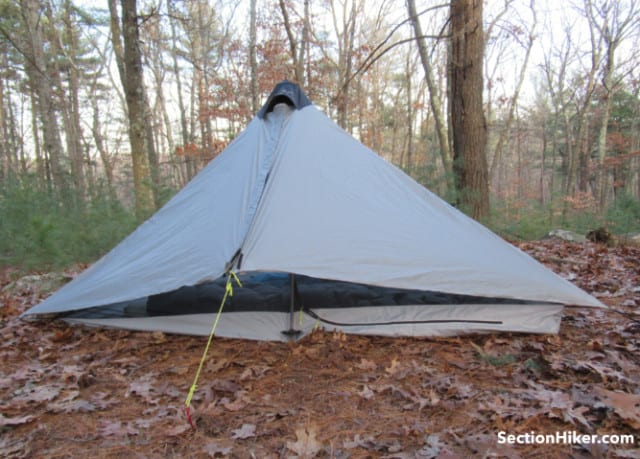
The vestibule is also somewhat untraditional, in that it doesn’t reach all the way to the ground, but has a gap at the bottom. This is to promote airflow in order to prevent internal condensation. It does require that you be conscious of wind direction on cool nights and that you pitch the vestibule away from the wind direction so that the breeze hits the rear of the tent instead. I can recall one particularly cold night when I didn’t heed this advice and I had to use my backpack as a bivy sack for warmth when cold wind blew into my tent.
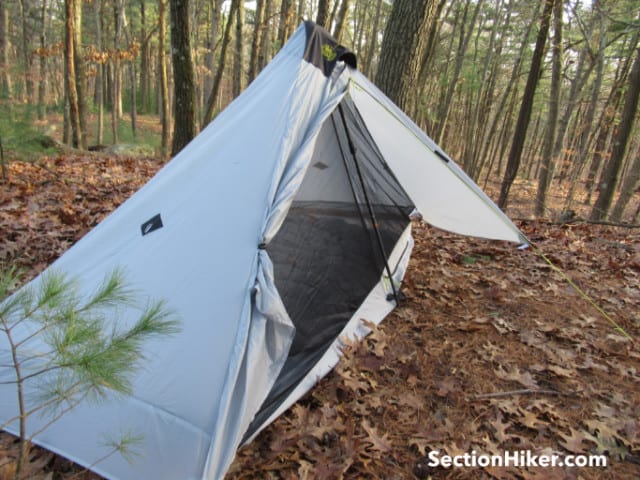
The most important tip I can share when setting up any pyramid-like shelter like the Lunar Solo, is to keep the guylines as loose as possible when staking it out, only tightening them once the main pole has been set. This gives the shelter the ability to adapt to potentially uneven or slightly sloped terrain.
The pole is pitched at a slight angle so it doesn’t intrude into the living area. The top of your trekking pole fits into the tent peak, which also has a top vent (the Lunar Solo is Pacer Pole compatible, as shown.) The carbide tip of your pole fits into a grommet attached to the tent floor, providing a nice stable support that won’t slip at night. There’s a single guyline that runs from the peak to the ground and prevents the pole from falling. It’s really quite a strong setup.

There’s a zipper that connects the two half-front doors, which you close above the front guyline. Each door has a small webbing loop at its base which you can connect to a prusik knot that travels along the front guyline. This lets you tension the doors down or up, or connect one to the guyline and not the other.
The interior of the Lunar Solo is quite comfortable and spacious with plenty of headroom to sit up or change your clothing inside. Like all pyramid shelters, the head and foot ends slope down, but the floor is long enough (90″) that there’s little risk of internal condensation transfer. There are also additional guy-out points halfway up the sidewalls that you can guy out with extra cordage to increase the interior space and anchor the tent down in high wind.

While the Lunar Solo has a bathtub floor, the height of the sidewalls can vary from flat, up to 6″ in height, depending on a subtle interplay of factors such as the height of the pole, the flatness of the ground that you pitch on, and the amount of tension exerted on the guylines. Getting the right combination of factors can be very hit or miss, so your best bet is to focus on good campsite selection to compensate for a less than perfect pitch. That means pitching the tent in a well-drained spot and over porous soil or forest duff in order to avoid pooling water if it rains.
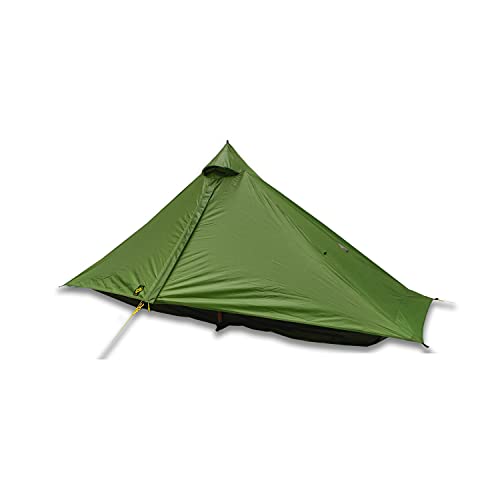
Having used a dark green Lunar Solo and the gray one shown here, I far prefer the green-colored shelter because it’s stealthier in the forest and lets less light in through the fabric. But that’s just my personal preference. The gray tent shown here was seam sealed by Six Moon Designs and I’d recommend having them do it instead of doing it yourself. They do a far better and cleaner job at it than I’ve ever done.
Comparable One-person Ultralight Tents and Mids
| Make / Model | Weight | Type | Material |
|---|---|---|---|
| Six Moon Designs Lunar Solo | 26 oz / 740g | Single Wall | Silpoly |
| Six Moon Designs Skyscape Trekker | 28 oz / 790g | Single Wall | Silpoly |
| Gossamer Gear The One | 17.7 oz / 503g | Single Wall | Sil/PeU |
| Lightheart Gear Solo | 27 oz / 765g | Single Wall | Silnylon |
| Lightheart Gear FireFly | 29 oz / 822g | Single Wall | Silpoly |
| HMG Ultimid 2 + Half Nest | 33.38 oz / 964g | Mid + Nest | Dyneema DCF |
| Zpacks Plexamid | 15.3 oz / 433g | Single Wall | Dyneema DCF |
Recommendation
The Six Moon Designs Lunar Solo is a 26 oz single-wall trekking pole tent that’s good for three-season use. It’s simple to set up with a little practice and easy to anchor down in a stiff breeze, with extra guy-out points on the fly should you need them. Internal condensation is easy to keep under control, provided you practice good campsite selection and keep the vestibule partially open at night. But the thing I’ve always liked about the Lunar Solo is its spacious interior and headroom. The tent’s height and hexagon footprint provide plenty of space to sit up, change clothing, and store extra gear inside the tent when you want a little privacy or to grab some shuteye. At $230, the Lunar Solo also continues to be one of the best deals money can buy when it comes to ultralight 1-person tents shelters from “cottage” manufacturers, especially when compared to those charging exorbitant prices for Dyneema DCF tents and tarps.
Six Moon Designs Lunar Solo
Comfort
Ease of Setup
Weather Resistance
Durabilty
Weight
Packed Size
Disclosure: The author received a tent for this review.

I have had the Lunar solo for about ten years, and I have used it frequently and in variable settings. I can attest to its durability, but the hexagon shape is awkward and takes up too much space in small campsites. In an open, flat setting, it works well.
The Six Moons Gatewood Cape really should be on this list as it uses the same net tent. The Gatewood cape is an amazing weight saver as the cape doubles as your well ventilated rain gear. The 11-oz Cape + 11-oz Serenity Solo Net Tent clocks in at 22 ounces minus the say 10 oz for your rain gear and you have lightest solution out there of a net 12 oz (after tossing your rain gear). I’ve had this combo in some ferocious thunderstorms, including at top of Opie Dilldock Pass on the PCT during a particularly dark and stormy night. The vestibule area outside of the net is just big enough for a pack and boots – you do need to be careful to not kick your boot out from under the vestibule to just under the drip line (yes, there is a very wet shoes story in the morning about that one).
Love my Cape, but I’ve never had the guts to use it for rain gear because I get scared about setting up in the rain.
I read a review somewhere from a guy who said he can wear the cape and change out of it and set it up as a tent from within the cape during rain without getting wet, but that it needs a bit of practice.
At one time I was very interested in this tent but with the advent of newer Tarptent designs I found them to be what I wanted.
Bought me a Six Moon Lunar Solo last year, while pleased over all with the tent. I don’t understand why Six Moon don’t seam seal as standard, had me a long night sponging out first time hit by heavy weather. A hairy night few days back, set tent up behind some small gorse bushes ( top of Compton Down, Isle of White, UK ). Wind picked up to 50 knots during the night and what with a change in direction, tent was all over the place but held up. Not the best of spots to stick ya tent in a Southwesterly for sure, being a few miles east of the Needles. So tents doing OK !
It’s a good tent, but you have to seam seal it before use or pay for them to do it. Why they don’t just sell it sealed. I suspect that has to do with their offshore manufacturing process and cost structure.
I saw it at the 2019 Black Friday sale at 20% off retail. Around $185 from Six Moon.
Pitching it to get the bathtub at 3″ is tricky and not uniform around the floor. Maybe 1-inch on one side, 3-inch on the other and 1/2″ on another. Bathtub height is determined by how extended you have the pole. That said, I have not used this tent in rain so cannot comment on the bathtub floor effectiveness. If you zip up the fly there is much condensation inside the tent. Keeping the fly extended using the prusik knot stops condensation.
That’s the downside of a trekking pole tent. Takes more tweaking with pole height and site selection to get a taut pitch. On the flip side, you can set up the tent in rain and keep the inside dry.
Love the low weight, but have found over this summer that the toe box on my bag always hits the tent and there’s always condensation. always. not quite enough room on a wet night for your gear inside, and the vestibule covers some, but does not pull down quite down to cover entirely, resulting in some wet pack bottom.
I’m wondering if anyone has used Gossamer Gear’s The Two for a little more internal room. Laying on a Thermarest neoair xlite pad, is a bit slippery inside, even with silicon dots applied to bottom. I toss and turn and its often a wild ride sleeping inside. Will continue to use it, but still on the look out for more refinements.
Try using 1/8 inch insulating pad under your mattress. Almost no weight, easy to pack, and helps stop the sliding. Also provides a little extra insulation. You can get one from Gossemer Gear.
Hi Phil, your photos are of a older version of the Solo before they out sourced it. The black peak is a dead give away.. I own 4 revisions of the Solo dating back 12+ yrs with the most recent purchase in 2019. The newer version is just a terrible mess.. The mosquito netting is niw half the width, the metal eyelet is replaced by a sleeve that will allow your pole to puncture the peak if not careful, the stuff bag is 30% too large, the colors are not color fast…they fade even before your first pitch. SMD was offering discounts just to off load these rejects. The older Solos with the black peaks are stellar!! Over the summer I bought my first Lanshan 1 Pro from 3F UL for $156. It retains all the best features that the Solo used to offer. I now have two brand new 2019 Lunar Solos for sale. Discounted. One is my daughter’s that I bought for her for Christmas that she refusied to replace her 12 year old solo with.
They were the first brand to offshore to China. Been doing it for ever.
Most tents are sealed during assembly with seam tape, so they don’t need seam sealing after. The floor of the Lunar Solo is coated with silicone on both sides, so it won’t take seam tape, therefore needs to be seam sealed. You can pay $35 for SMD to do it for you, probably an hour or so of labor cost. You can buy seam seal for $7 and do it yourself, it’s not complicated. I think this is why SMD gives you the option of doing it yourself. Otherwise the Lunar Solo would cost an additional $35, not as an option but standard.
I think you’re a little confused. First off the Lunar Solo is made entirely with siliconized polyester not silnylon. The difference is that polyester doesn’t sag as much when wet. Secondly, tents made with this fabric cannot be seam taped because the silicone makes it too slippery. The entire tent, not just the floor is made out of this material. Therefore all the seams and most especially the ceiling seams need to be seam-sealed before use if you intend to stay dry in rainy weather.
In your opinion is this enough better than the Lanshan Pro 1 to justify the extra expense? I know this uses silpoly which definitely has benefits, but are their factors you think are clearly better in the Lunar Solo?
https://sectionhiker.com/lanshan-1-pro-tent-review-2/
I’d go with the Lunar solo because it’s poly and because you can pay them to seam seal it for you. But it’s not a slam dunk one way or the other.
Great review, I enjoy my lunar solo,I bought it about 15 months ago, maybe 30 nights in it. If it is not going to rain I try to pitch it a little higher for venting. And I think it’s important to use your other pole and a stick to guy out head and foot to give you a little extra room so you don’t touch ends. All my gear fits inside with me no problem. 5-9 185lbs. Wide reg. X-lite. I have not really noticed any bad stitching and I had them seam seal it. With no complaints. I like the silpoly and guy lines with line locks compared to older models. I have the green model. Better for stealth camping for sure.
Just bought one at Black Friday to replace an older (heavier) 3FUL Lanshan. Better materials and packs down smaller/light than the Lanshan. Excited to take it out this spring in the Ozarks.
It was my first UL tent. It’s a really great classic.