 SectionHiker.com Backpacking Gear Reviews and FAQs
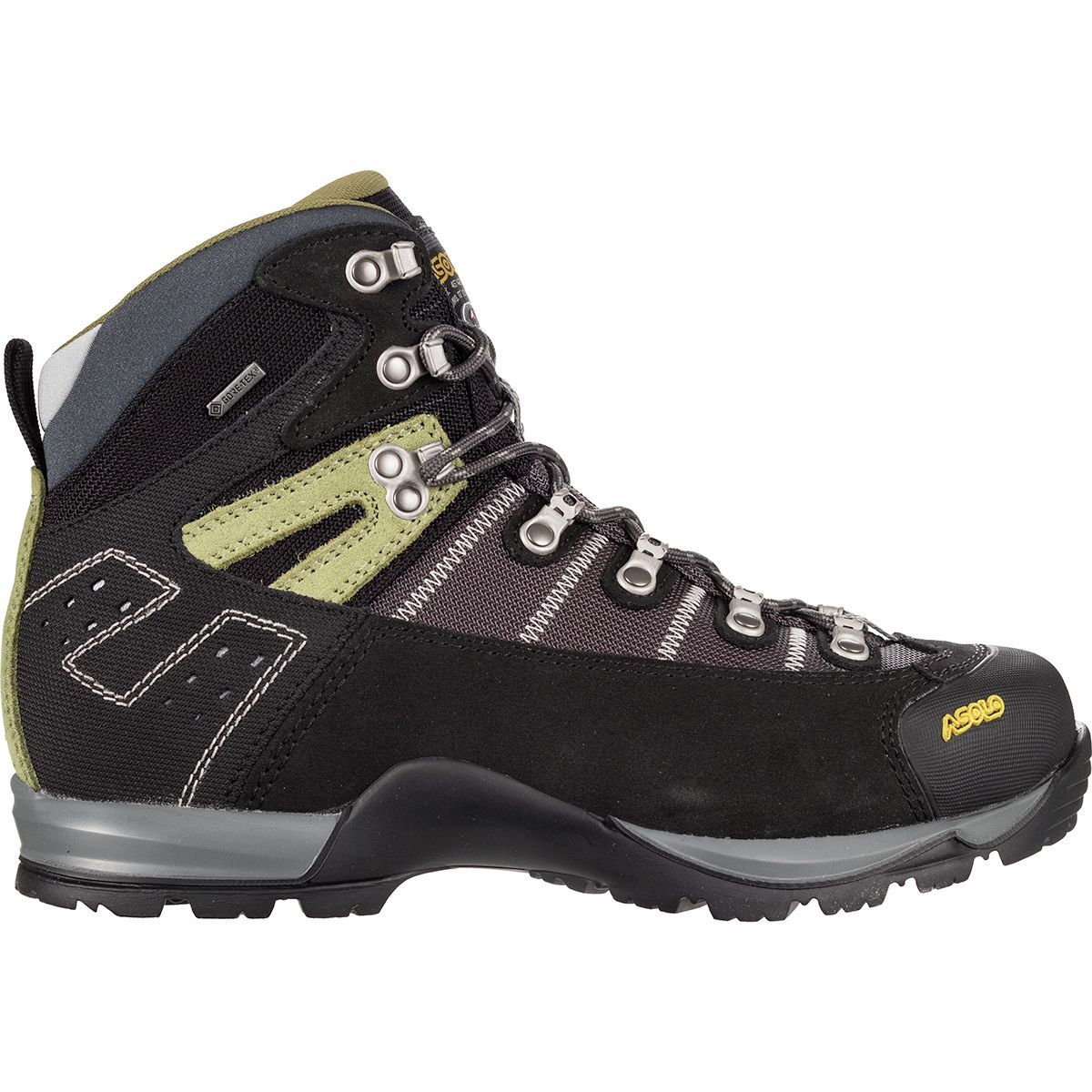
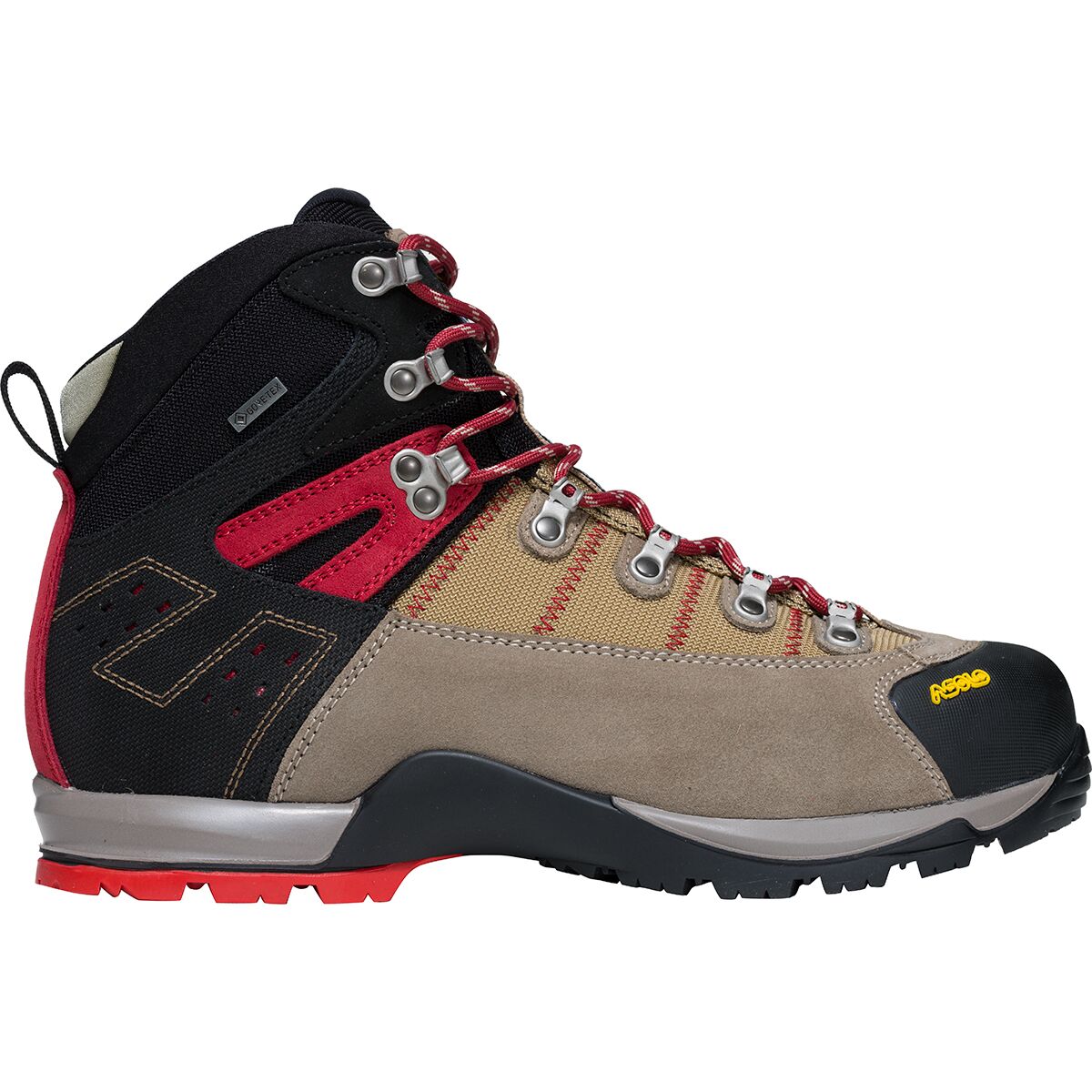
It never ceases to amaze me just how popular Asolo Boots are in the White Mountains of New Hampshire. I’d say that 75% of the 3 season boots that people wear up here are Asolos, evenly split between the leather TPS 520 and the Asolo Fugitive GTX, shown above. That from a company, that as far as I can tell, markets purely by word of mouth in the United States.
I own both of these boots and am on my third or fourth pair of leather ones at the moment. I bought the Fugitives and a pair of Asolo Flame GTX boots about midway through the summer because I wanted to try a boot that would be lighter to walk with when wet and that dries faster than leather. Since then, I’ve been systematically breaking in the non-leather boots and evaluating them for future use in boggy terrain or hikes that will require a lot of stream crossings.
So far I’ve found that the non-leather Asolos require about 30 miles of hiking to break in fully. Wearing them to the office and around the house doesn’t count. When they’re broken in, you’ll be able to tighten the uppers enough to lock your heel down in the heel box. Until then, you’ll feel your foot sliding around a bit.
Let me reiterate: it is a myth that the non-leather Asolo boots don’t require a break-in period. They do.
Having tried both the Fugitives and the Flames, it’s worth noting the similarities and differences between the boots, while I describe the Fugitives in more detail.
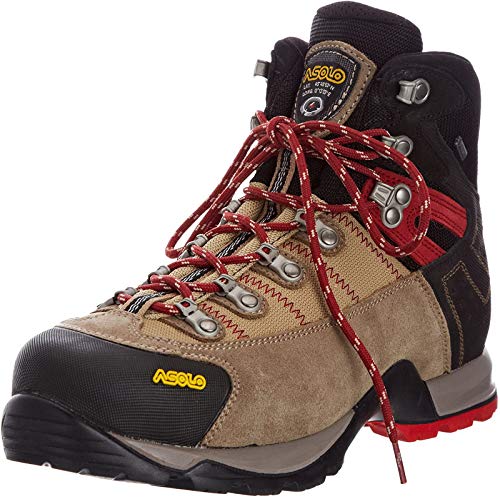
The Fugitives are slightly heavier boots than the Flames, both in weight and construction. In a 9.5 US, men’s, the Fugitives weigh 26 oz per boot compared to 24 oz for the Flame. Externally, there is very little difference between the boots. They are both made with suede lowers and ballistic nylon uppers, with substantial toe kicks and aluminum shoelace hooks, like you find on mountaineering boots. There is significantly less padding around the top of the boots than in the Asolo all-leather models, but the boots are still perfectly comfortable.

Internally, both boots are Gore-tex lined, which I actually like, because it extends their season in colder months. In summer, they’re warm, but slightly cooler than leather boots, given that I wear two layers of socks when hiking.
The real difference between the boots is in the sole and the last. The Fugitives have a much stiffer feel than the Flames. This is due to the construction of the last and footbed which has several layers bonded together to prevent pronation, supination, and torsion. The Flame’s footbed emphasizes shock absorption not stiffness and has a less complex footbed architecture. In English, this means the Fugitives are good for multi-day treks and the Flames are a day hiking boot.
Fitwise, the Fugitive is noticeably larger inside than the Flame. It is wider and higher inside, enough so, to fit a Green Superfeet replacement insole. This is impossible in the Flame, which has significantly less vertical space, and you must use the factory insole. This hasn’t proven to be a problem on day hikes, but I will not take the Flame on a multi-day trip for that reason alone. The risk of plantar fasciitis is not worth it.
Regarding the extra width in the Fugitive: this is easy to narrow by tightening the laces when the boot gets broken in, but you need to be patient and complete the break-in period before you conclude that the Fugitive is too wide. On the flip side, if you have very wide feet, the grey/black version of the Fugitive GTX comes in an extra-wide size.
The Fugitive also feels a bit longer than the Flame, enough so, that I’ve experienced a lot less toe pain when hitting rocks or hiking down steep downhills than in the Flames. At first, I thought that the toe kick on the Fugitive was larger than the one on the Flames, but they are in fact both the same size.
So to wrap up, if you are shopping for non-leather boots and you have a wide foot, need better support from a 3rd party insole, and plan on multi-day trips, I recommend you try the Asolo Fugitives. If you have a smaller, narrower foot and are looking for a day hiking boot instead of a softer mushier mid, like the Keen Targhee, you should give the Asolo Flames a try. Personally, I look forward to hiking with both of these boots more next year and plan to wear them out.
Disclosure: The author owns this product and purchased it using their own funds.
Compare 4 Prices
-
 Backcountry.com
$265.00$145.72View -
 Backcountry.com$299.95View
 -
 Amazon US$300.00View
Amazon.com Price: $300.00 (as of 04/24/2024 21:20 GMT-0400) Details
Product prices and availability are accurate as of the date/time indicated and are subject to change. Any price and availability information displayed on Amazon.com at the time of purchase will apply to the purchase of this product.
-
 REI$300.00View
 -

 Eastern Mountain Sports$300.00View

They look like nice boots. I'll have to check them out at REI on my next visit. Same price ranges as leather Asolos. I actually prefer leather myself.
Excellent review. This site is great!
Just picked up a pair of Asolo Flames, they are so far the best fit for my heal, and feel solid, however my forefoot feels a little squished.. buti think they may break in with time. Im concerned with the article-authors description that they may not be good for multi -day hikes. Yet they are more expensive than the fugitive price.. and supposidly more advanced in technology. I want somethign for hiking, packing once in a while and every day use..
any suggestions?
You can absolutely backpack using the Flames. Heck some people hike in sandals. But for me, I'd want a bigger roomer boot like the fugitive for serious backpacking. However, if your priority is for everyday use, I'd go with the flames. They're more of a utility boot for hiking and kicking around town.
Having hiked a lot with the flames, I can tell you that the toe box will not expand with use, like a leather boot. They will get a little softer, but not larger.
Asolo hiking boots are some of the best, as stated here, by far. They aren't as heavily marketed like you said, but man are they awesome! Great construction and bang for your buck. I've had several pairs for work and play. They're great for both. Some models are a bit pricey, but will definitely last way longer than other brand name boots.
Wow, great review. I have never even heard of Asolo Boots. I live in the chicago area and will now have to go hunting to find some.
I miss the Asolo TPS Highlands. Better soles than either of these.
I wonder how these would compare to the Asolo 95 GTX? I own a pair of the 95 GTX's and found them rather stiff, hot, and uncomfortable. Nor have I been very impressed with the traction of the non vibram soles.
Frankly I prefer a more flexible boot, which I believe provide a surer grip on wet rocks. To that end, lately, I have just been hiking in a pair of waterproof Merrel trail shoes. While they're hot as hell (only good from 30F to 50F), the flexibility and traction are phenomenal. After doing a 10 mile hike in them, my feet still felt OK. Though I did have to stuff some insoles in them cause they were too voluminous for my narrow feet. In contrast, after doing a 10 mile hike in the Asolo 95 GTX (with OEM insoles), my feet were killing me. I probably should (before selling them in frustration) stuff some insoles into the Asolo's…that is if they'll fit.
To Mike K –
The traction on my Fugitives is outstanding…I hike in the Adirondacks on slippery rocks with great results with them. They're stiff, but not too stiff. I do use an insert (Green Superfeet), and have never had a problem with blisters, slippage, wet feet, or any other issues..I love them, and have convinced my wife to get a pair, and she feels the same way.
As for heat, I hike in them almost year round with no issues…from light snow, to mid-summer.
What is the female version of the Asolo Fugitive??
Melanie – my wife has Fugitives too, but they seem to be harder to find lately. She got them at our local EMS…
I returned my Fugitives after only two 3 mile hikes. They where killing my feet. Heel blisters on both feet and my feet felt very sore. These boots have a stiff hard sole, that does not allow your feet to move naturally. I got fitted for these boots at EMS. The guy did a terrible job and I believe he was only interested in the sale. I will not shop there again.
Darrin – You keep leaving negative EMS comments on my web site. Have you considered contacting EMS about your concerns. It sounds like the store you visited has a serious customer service issue that needs to be addressed for the benefit of all customers.
I did Philip and I got my money back. Thanks for your concern!
Great review. I recently purchased both the Fugitives and the TPS-520 and am in the midst of breaking them in. I almost bought the Lowa Renegade GTX instead of the Fugitives (because of their out-of-the-box comfort) but concluded that I wanted something I could trust for longer trips and heavier loads. I don’t regret it. Thanks for a great review and offering perspective by comparing a couple of different boots. I always feel that when you’re discussing a boot, it’s always helpful to compare it to another one for perspective. That’s why I try on about 50 before I choose one! Just kidding…
It seems like they are only making a wide version for the Wool/Black (actually like a tan), not the other colors, and the Flames are discontinued. I had a pair of Fugitives and I have to say the build quality is outstanding. I lucked into a new pair for $40!! New in Box at Salvation Army. I’d like a wide in the grey. The side of my toe hits the front where it gets narrow. A larger size would be way too big. I kind of disagree that these are a spacious boot. Many people say they like the Fugitive because it is narrow. I just tried the Saloman Quest 4D and those are roomy, very big toe box in the regular width. And extremely comfortable. But, at the same price the Asolo seems to have twice the build quality at least. Other colors are nicer, but if wool/black wide, fits better, I’ll get another pair.
you can heat and shape the toe cap on the fugitive to make it more spacious. My little toe was getting blisters until i did this. It works to help break in the heel cup too. I heated mine in a waterproof bag in hot water on the stove. Then put the boots on whilst hot, laced them, shaped the toecap and went for a walk to break in the heel cup. Worked a treat.
Jack, you are on to something. My 10+ year old Asolo’s life has come to an end (lost!). A very, very sad day for me. Ready to buy a new pair (520s would be the same replacement), i started doing some checking. No longer made in Italy (not a good sign). Recent problems with material failures (foam adhesive that holds the sole to the shoe) from what is probably the use of the wrong product in manufacturing or perhaps the more common causes are the Romanian manufacturing and not applying the foaming adhesive properly, curing or something similar. Asolo refuses to acknowledge any problem and there seem to be a lot of reports of very early (ie. less than 1 year) sole separation. (not good sign #2). Finally, they have changed the long-time, perfect (for me) last about 6-7 years ago. The new last has what seems to be a popular modern day fit (narrow heel and oversized toe box to compensate for the heavier population) and mis-understanding of proper shoe/boot fit. I guess it is probably that being correct is less important as being popular. (third and final nail in the coffin for buying another pair of Asolos – though I did just buy a pair for my daughter as her feet are still growing and I am assuming the Asolos will last at least one year).
Going the Zamberlan route – liking everything I read about them. I’ll reconsider Asolo’s when they move back to Italy, figure out either the correct adhesive foam or at least how to reliably use it. Until then, I’ll stick with the Italian artisans who build shoes very well. I just wish I could find a Zamberlan retailer in the midwest to try them on before buying.
I bought these boots three years ago. They are still in excellent condition! I’m pleased with the purchase