 SectionHiker.com Backpacking Gear Reviews and FAQs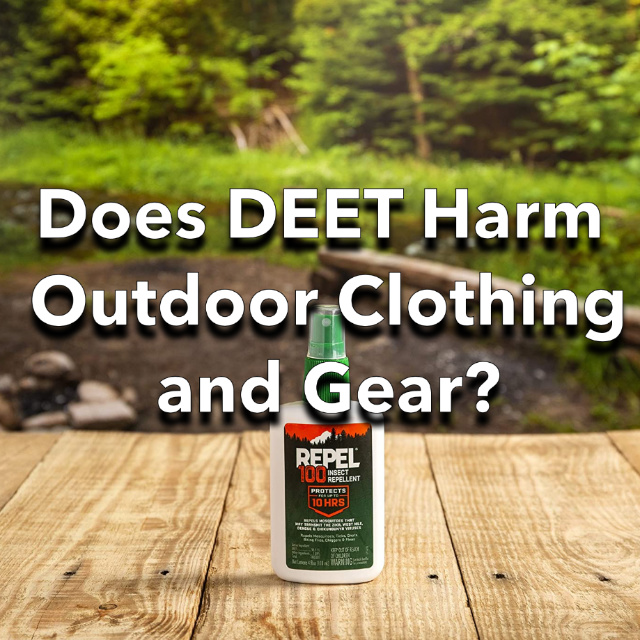
DEET in all concentrations can harm outdoor gear and clothing made with synthetics, like nylon and waterproof/breathable membranes, as well as plastics. It doesn’t harm outerwear or gear made with natural materials, however, including cotton, wool, aluminum, or steel.
While DEET is safe to apply to your skin as an insect repellent, it’s not designed to be applied or sprayed-on clothing or gear. If you do get it on your finger and hands, it acts as a solvent and may dissolve or permanently fog plastic glasses lens including sunglasses, watch crystals, or GPS and Satellite Communicator screens. It can also damage or even dissolve rain gear and any clothing or gear that includes spandex, rayon (also known as viscose), rubber, latex, vinyl, and elastic.
Picaridin – For People
Unlike DEET, Picaridin is safe to use around plastics, synthetic apparel, and gear with synthetic coatings such as sunglasses, watches, GPS units, or phone screens. Picaridin became available in the United States in 2005 and is used widely in Europe as a replacement for DEET. It repels mosquitoes, ticks, biting flies, sand flies, gnats, chiggers, and midges. The most effective concentration of Picaridin is 20% and will last up 8-12 hours before repeat application is required. It’s also safe for children over 2 years of age and pregnant women.
I switched to Sawyer Picaridin five years ago, after using Ben’s 100% DEET for many many years, and there’s no difference in its effectiveness as an insect repellent. I made the switch because I got sick of the damage that DEET made to my outdoor navigation gear including watches, compasses, and GPS units. It just got expensive to keep replacing after a while.

Permethrin – For Clothing and Gear
If you have clothing or outdoor gear that you want to make insect-proof, the best way to treat it is using a product called Permethrin which doesn’t hurt your gear like DEET. Permethrin is sold as a spray-on (Sawyer Permethrin) or as a liquid in bulk (JT Eaton) that you can soak items in. It actually kills mosquitos and ticks that land on clothing treated with it, as opposed to just repelling them. Permethrin lasts for 6 weeks when you apply it yourself. I’ve sprayed it on socks, gaiters, shorts, pants, and hats. I’ve been using it for over a decade without any ill effects. I know people who spray it on their tents and tent footprints too.
If you want a more permanent Permethrin treatment, you can also send your clothing to Insect-Shield which has a special process that will last for 70 washings. In other words, it will remain effective over the span of years. You call also buy outdoor clothing that has been pretreated with Insect-Shield (also called BugsAway, Noilife, etc) which I’ve also been doing for many years. If you wear clothing that has been treated with Permethrin or Insect-Shield you can cut way back on the amount of insect repellent that you have to apply to your skin. I hardly use any anymore, unless the bugs are really bad.
I’ve been using Insect Shield treated clothing, head to toe, for the past 10 years in the SE US. In that time I have had precisely 1 tick…it crawled up under my watch band after I had rolled up the sleeves of my shirt. Mosquitoes have never been a problem when fully dressed in IS treated clothing. They buzz around me, but do not light, never coming closer than 4-5 inches from my face.
Excellent article, thank you! I didn’t realize that DEET can affect plastics and items such as watchfaces and electronic screens.
Yeah – it’s terrible. Fogs them permanently so they’re unusable. Sunglasses too.
I used 100% DEET when working in the Belize bush decades ago. All kinds of nasty bugs down there. It’s effect on dissolving plastic (and transferring same to your skin) was really impressive.
I’ve switched to Picaridin as well–while DEET appears to be safe at concentrations up to 30%, Picaridin seems like a safer bet, health and chemical-exposure-wise.
The Environmental Working Group (a consumer protection org) has a very useful guide to these chemicals here:
https://www.ewg.org/consumer-guides/ewgs-2018-guide-bug-repellents#Picaridin
Their bottom line is that nobody should be using DEET at concentrations above 30%, and they prefer Picaridin.
With regard to “Their bottom line is that nobody should be using DEET at concentrations above 30%”, that statement is not what is contained in the link you provided. The 30% recommendation comes from the Canadian Government with no scientific basis for it. The considerable research mentioned prior to that Canadian Government comment clearly states that 100% DEET is safe, and no ill effects are observed at normal rates of application.
Let’s not perpetuate unfounded concerns.
Philip, I send my clothes in to Insect Shield. They have great customer service and quick turn around times. Insect Shield states when they process your clothes, the Insect Shield will last 70 washings. I found out about them from an article you wrote. It’s more efficient for me to send my clothes to them.
Fun fact about Permethrin (according to the Sawyer packaging) is that you can treat your dog’s coat with it for extra protection. It’s an insecticide after all and it’s claimed to be dog safe (safe for dogs to ingest as they groom themselves, though explicitly says not cat safe). I haven’t tried this, but note you absolutely CANNOT do that with DEET.
The active ingredient in K9 Advantix is permethrin. I also use a permethrin spray on my horse.
In defense of Deet, I use 100% all season long, taking reasonable precautions no to spray in on synthetics or allow hands wet with solution in contact with plastics. I’ve never had damage to plastic or clothing after wiping my hands down, which I would do regardless because the taste (transferred to food, or when wiping your nose) is terrible.
I treat my socks, boots and lower pants with Permetrin. While walking in tick infested southern new england brush, I rarely have a tick on the clothing. Probably it would have died had I not flicked it off.
That said, its clear I should give Picaridin a try. If it works as well as DEET without the damaging solvents, then it is a superior choice.
BTW, I’ve never understood the claim that diluted DEET is safer than 100% DEET. If you look at the label of each you’ll see the 30% has another ingredient(s) called 70%, Other Ingredients. For 100% DEET the Other drops to 1.9%. To the best of my ability to identify the Other Ingredients, it is water. If its water, then using a lower concentration of DEET simply allows you to spray the same volume from the bottle as you would for 100% DEET. One is 100% DEET, and the other is 30% of 100% DEET plus 70% of 100% Water. Simple solution, carry 100% DEET, spray less. No safety issue here that I see.
I used the link provided in this article to purchase Picaridin from REI, but stopped to read the reviews. What I found is that there are many reviews that testify Picaridin is not as effective at DEET. It appears that people familiar with DEET who tried it found it works on light concentrations of bugs, or on mosquitos but not black flies. Also many complaints about the container. It leaks. Must be carried in a ZipLock or other watertight bag.
I’ll buy some anyway and do a two arm test.
It works just as well, really. One benefit of Picaridin they don’t mention is that it won’t dissolve your backpack pockets if it does leak. :-)
I have had that happen with DEET and it is so fun.
I switched to Picaridin lotion and never looked back, finally get just as effective as deet and much less “greasy.” I buy a box of the flat, small lotion packets from Amazon. One packet provides two or three applications, thus sufficient for a whole sweaty day in the woods. I keep the packet in a sandwich bag in my hipbelt pocket to keep the lotion from smearing anything. I still put it in my bear canister at night even though it doesn’t have much odor at all.
For black flies try https://www.oletimewoodsman.com/?ref=StoreYa&utm_source=stry&utm_medium=trafb&utm_campaign=storeya2b&utm_term=kwd-300846660940
Thanks for the info regarding deet. I learned the hard way that it will destroy the waterproofing on a brand new pair of boots.
It is a solvent…
My complaint two two fold: (1) the smell turns my stomach (unfortunately the alternatives are not much better), and (2) the last straw – putting DEET on my face ruined a $500 pair of prescription trifocals after DEET on my face dissolved the lens coating and smeared them into uselessness. Before I figured out the cause, I ruined my backup $500 pair of glasses (on the same car camping trip) and nearly couldn’t drive the 12 hours home. Why oh why is this stuff still on the market? Find another formulation that doesn’t do that.
DEET will not only dissolve some plastics but can result in a chemical burn to the skin where plastic contacts DEET on your skin. I had this occur while in the Amazon jungle after liberally applying DEET to my exposed neck area and then carrying binoculars with plastic strap around my neck. This resulted in a painful burning sensation later in the day and left a burn around the backside of neck where the strap contacted and dissolved. For months I had a scar on the back of neck that looked like the jungle head hunters almost got my whole head. No more DEET for me.
In the Minnesota Boundary Waters, I put some 100% DEET on my neck, then, later, put on my new Montbell Gore-Tex rain jacket. On later trips the jacket leaked around my neck and shoulders, but the outer nylon appeared to be fine. When I held the jacket to a light, I could see that the membrane in the jacket had dissolved away in those areas. I asked about this on an AT hikers’ blog and two or three dozen people wrote back and said “same.” After I switched to Picaridin, I realized that unlike DEET, it didn’t put me in a bad mood. I’m telling these stories only because I want to contribute to this newsletter, which I think is the only worthwhile thing on the internet. Thanks Philip and everyone else who tests and writes for Section Hiker.
Thx. We try hard to keep it very meaty, modest, and level-handed.
I am a Long-Distance Distance hiker who has hiked all eleven National Scenic Trails. Unfortunately I have also had 3 tick diseases: Lyme disease, Colorado Tick Fever, and Rocky Mountaiin Spotted Tick Fever. So I can tell you from learning the hard way that these tick born diseases are miserable and can be deadly if not treated immediately!
I’ve found Picardin and Permethrin to be a life saver and have not had any more tick fevers for 11 years now since using Permethrin and Picardin.
HikeOn!~~~