
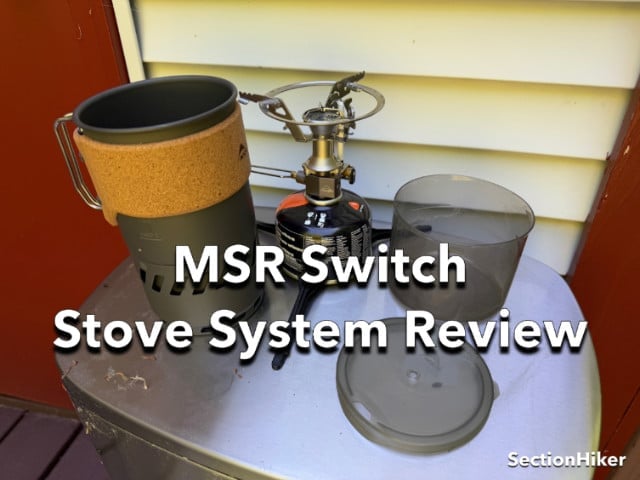

The MSR Switch is a compact camping stove system designed around a heat-exchanger pot with an unusual bulbous bottom. The system includes a pressure-regulated stove with a piezo igniter and an integrated pot stand sized to support the cook pot, but the stand can expand to accommodate larger pots or frying pans for group cooking.

In addition, the pot comes with a plastic lid with colander holes, a plastic measuring cup, a versatile fuel canister stand that prevents the cook system from toppling over in use, and a mini packtowl for cleaning and to stop the components from rattling together when you hike (I’ve already misplaced the mini towel, though).
- Total weight without fuel: 13.8 oz
- Stove w/stand weight: 4.1 oz
- Cookpot capacity: 1L
- Fits a small 4 oz isobutane canister when packed
The standout design element is the hemispherical bulbous bottom of the integrated Switch pot. It rests on a ring-shaped stand that surrounds the stove’s burner but is held in place only by gravity, so you need to be very careful not to tip it over onto the ground or into your lap.

The pot is a heat-exchanger pot, similar to an MSR Reactor or a Jetboil Flash Cookpot. Stove systems with heat-exchanger pots are about 20-30% more fuel-efficient than regular pots because they retain heat longer, reducing the amount of fuel required for cooking or boiling water. The pot has a lid and handles, but is surrounded by a flame-resistant cork sleeve instead of a cloth cozy. The ring-shaped pot stand has hidden arms that can fold out to accommodate a wider cook pot or frying pan, up to 8″ in diameter, for group cooking, if you’re willing to carry the extra cookware.

The combination of all these parts looks like something out of Mad Max with what appear to be cannibalized components from an MSR Windburner Stove System, an MSR Reactor, and an MSR Pocket Rocket 2. It all works together, but it looks kind of post-apocalyptic.

But the component that tickles my fancy the most is the fuel canister stand, which can stretch to accommodate different canister sizes and dimensions with ease. If you’ve ever struggled to fit the folding orange canister stands that come with other stoves and stove systems to an isobutane canister, you’ll appreciate this elastic canister stand (the middle piece is elastic). I tried it with canisters from MSR, Jetboil, and Snow Peak, and it worked with all of them. (I think they should sell it as a standalone product.)

Performance
Heating performance is strong thanks to the bulbous pot bottom and the ring stand, which positions the stove head for optimal heat distribution. Furthermore, the pot is made of anodized aluminum due to its even heat distribution and longer heat retention (compared to titanium.) I clocked boiling at about 2:10 for a 0.5 liter.
Unfortunately, it’s very difficult to tell visually when your water is boiling on the Switch stove. There is no external indication, so you have to take the lid off to look inside the pot. That’s problematic because the stove does not lock to the stove stand, making it very easy to tip the entire apparatus over unless you grasp the pot’s metal handles with one hand and remove the lid with the other. As a point of comparison, many of Jetboil’s stove systems have a thermal indicator on the cookpot cozy that turns red when your water is boiling, and their pots lock to the stove stand. It’s puzzling that a company named Mountain Safety Research (MSR) didn’t build more safety features into this product.

What can you cook in the MSR Switch Pot?
Although the Switch stove can simmer quite low, if you try to cook anything substantial, it will burn because the food that drops into the pot’s bulbous base will be hotter than the food at the top. Instead, I recommend you stick with water or a very brothy soup like miso.
For example, I tried to cook my favorite backpacking meal, a Knorr’s rice side, and it burned at the bottom of the pot within minutes, even though I stirred the contents constantly and had turned the flame as low as it would go without going out. I half-expected this to happen, but I was surprised by how quickly it occurred. Gear reviewers have to try all the edge cases…

I’m surprised that MSR doesn’t warn owners against cooking anything other than boiling water or very soupy meals with few solids. I’ve successfully cooked Knorr’s rice sides in countless backpacking pots and stoves during the past 20 years, and this was a first.
Wind resistance
Most stove systems that come with heat-exchanger pots benefit from good wind resistance. Not the Switch. Neither the burner head nor the pot provides any wind protection. This is because the base of the pot sits on top of the ring stand and not lower, where it could afford the burner head some protection. On a Jetboil, the burner head is positioned above the ring stand, so the sides of the Jetboil heat exchanger pot can protect the burner from wind. What you save in efficiency with the MSR heat exchanger pot, I suspect you lose. at least partially, due to the lack of wind protection.

Fuel management and flame control
One of the more notable technical features of the Switch stove is its pressure regulator. The regulator helps maintain consistent performance in cold conditions and at higher altitudes where canister pressure drops, and it improves fuel efficiency compared with unregulated designs.
Weight and packability
The complete system weighs 13.8 oz. (392 g), with the standalone stove at just 4.1 oz. (117 g). That combination, along with the ability to fit a small gas canister when packed, makes the Switch competitively attractive for weight-conscious users.
Pros
- Fast heating from the pot’s bulbous bottom.
- Flip-out supports accommodate a range of cookware up to 8 in.
- Pressure regulator for reliable cold- and altitude performance and better fuel economy.
- Lightweight, highly nestable kit
- Stellar fuel canister stand
Cons
- The system is easily tipped over because the pot does not lock to the pot stand
- The heat exchanger pot does not provide the stove with added wind resistance
- Solid food is easily burned in the bulbous bottom, limiting the stove’s ability to do more than boil water
- The cook pot has graduated fluid markings, but you can’t read them because they’re deep in the narrow pot or covered by the cork grip
Bottom line
The MSR Switch stove system offers a distinctive and efficient solution for backpackers seeking a compact, lightweight stove for boiling water. Its innovative bulbous heat-exchanger pot and pressure-regulated burner deliver fast, fuel-efficient boiling, while the expandable pot stand adds flexibility for group cooking. However, the design’s reliance on gravity to hold the pot in place requires caution to prevent tipping, the lack of wind protection and the difficulty of monitoring the boil status may all pose challenges for many users. Additionally, the pot’s shape makes cooking solid or thicker meals prone to burning, so it’s best suited for boiling water and simple soups. Overall, the Switch is an odd-looking assembly of components, and something that only the nerdy engineers at MSR (I admire them, actually) would dream of bringing to market. But it works well enough, and it’s sure to generate conversation from other hikers you meet on the trail. I’m not a huge Jetboil fan, but I think the Flash 1.0L is a better stove system for solo use.
Disclosure: MSR donated a stove system for review.
SectionHiker never accepts payment for gear reviews or editorial coverage. When you buy through affiliate links on our site, we may earn a small commission at no extra cost to you. Help us continue to test and write unsponsored and independent gear reviews, hiking and backpacking FAQs, and free hiking guides.
Great review and a dazzling display of common sense! This is why I love your reviews.
I come for his sense of humor. This one was worth a chuckle.
Can’t take this backpacking gear thing too seriously!