 SectionHiker.com Backpacking Gear Reviews and FAQs
The AOTU “Orange” lightweight canister backpacking stoves only costs $20.44 and is a best-buy for normal camping and backpacking use. We consider it one of the 10 best backpacking stoves because it’s such a good deal compared to similar and much more expensive stoves. The question that comes to mind is what you have to sacrifice for the price break, whether this stove is safe to use, and what kind of value the AOTU Orange stove provides. For example, is it safe and sturdy enough for boy scouts and more casual backpackers to use? How fast does it boil water? What are the best cook pots to use it with to boost efficiency?
AOTU Ultralight Backpacking Canister Stove
Fuel Efficiency
Weight
Simmering Ability
Time to Boil
Ease of Use
Gear Weight
Weight-wise, the Orange stove weighs 3.3 ounces and comes with a protective orange plastic carrying case weighing 0.6 ounces. In comparison, a Snow Peak Gigapower stove weighs 3.0 ounces and comes with a 0.8-ounce plastic carrying case, so the two stoves are pretty comparable in terms of weight.
Pot Stability
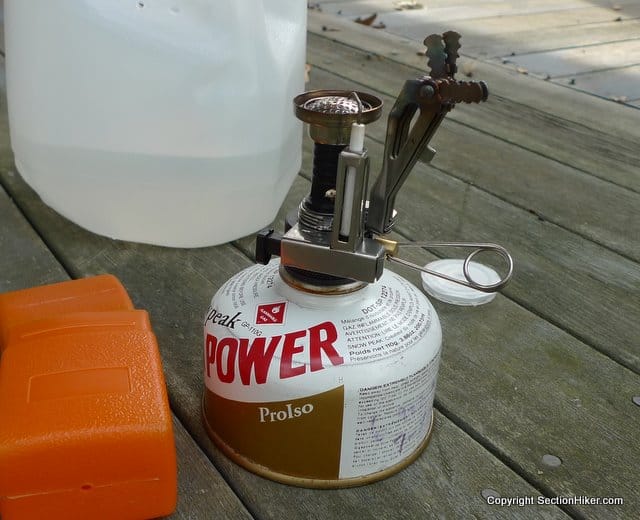
The Orange stove comes with a collapsible pot stand that folds away accordion style for storage. The stand has tiny feet at the end of each support member that rotate out to help hold a wider pot.
Unfortunately, I found that the stability of a narrow pot filled with water isn’t ‘t that good, and you can’t take the lid off the top of the pot, without worrying about whether it will tip over. In fact, the bottom of a narrow pot doesn’t even come into contact with the feet and instead rests on top of the metal rivet that fastens them to the vertical support member.
Wide pot stability is much better, however, and the bottom of a wider pot has complete contact with the feet, so you can open the lid and peek inside without having to worry about your dinner spilling out. This is a consideration for younger campers who might be a little less coordinated than adults in such matters.
Boil Times
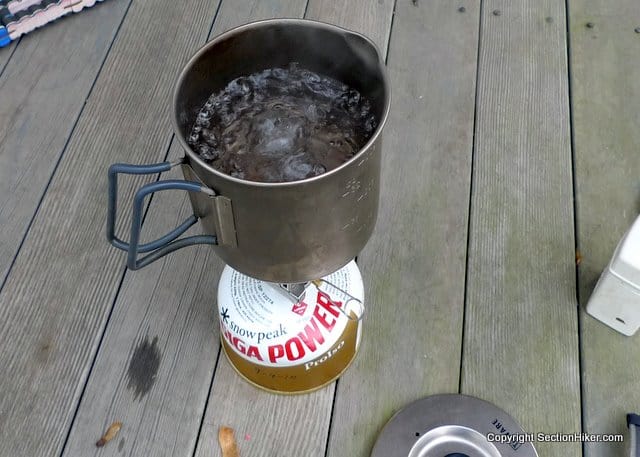
With a narrow pot, the Orange Etekcity Ultralight Backpacking Stove boils 600 ml of water in 4:45 and in 3:00 in a wider pot. As a point of comparison, the much more expensive Snow Peak Gigapower takes 5:30 to boil 600 ml in a narrow pot and 8:45 in the wider pot. That was an eye-opener for me!
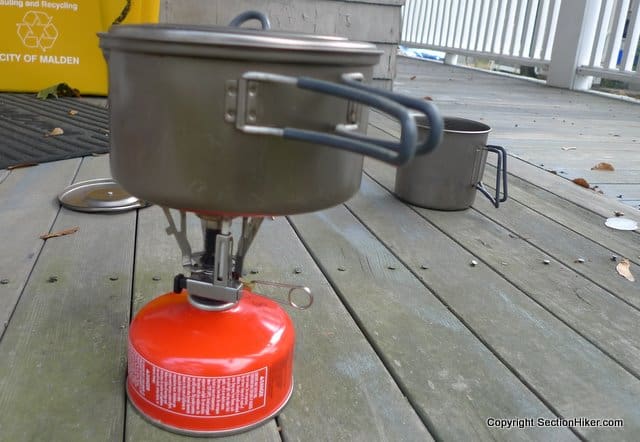
I attribute the difference in the boil times to the size of the stove burner on the Orange Etekcity stove, which is much flatter and wider than on the Snow Peak. This also explains why the Etekcity stove’s boil time on the wider pot is faster than on the narrower pot because less heat escapes up the outside of the pot.
Recommendation
I’m very impressed with the performance of the AOTU Orange Ultralight Backpacking Canister Stove.
At $20.44 it’s a great value for any backpacker. However, to take advantage of its speedy boil times, I do recommend that you use a wide pot like the Titanium Non-Stick 1.3L I used for testing this stove, to take advantage of the stove’s larger burner surface area and improve its efficiency.
Disclosure: The author purchased this product with his own funds.
SectionHiker is reader-supported. We only make money if you purchase a product through our affiliate links. Help us continue to test and write unsponsored and independent gear reviews, beginner FAQs, and free hiking guides.
These look great but the canisters they use for fuel aren't refillable, are they? Doesn't that just add to our already growing trash problem? I'm looking at buying my first stove this winter and am pretty sure I want to avoid adding to a landfill any more than I need to.
I tried the MSR WhisperLite and found it pretty darn useful (though I did pack way too much fuel).
Do you prefer canister stoves generally? And why?
I have had a whisper lite for years works great but you have to carry a big tank, also you still have to fill your tank somehow and once your canister is empty u can crush and recycle it any way.
Yeah, thos 110 and 220g resealable “butane” canisters are refillable. I’ve done it with a temperature differential driving the butane from the donor can into the empty, receiving can via 1/8″ tubing and that butane lighter refill adapter.
But it was more of a fun, technical stunt than a realistic solution.
If you put too many grams of butane into your concave bottomed canister, it violently pops out convex when it warms up. By “too many” grams, I refer to putting more grams of butane into the canister than it is rated for.
Doable, but a moderately large pain in the neck.
I pack canisters because they're convenient and fast to cook with. But they don't work in sub 20 degrees (F) in winter when, like you, I have to lug a much heavier liquid fuel stove around.
Google “Moulder Strip” and you’ll find various threads on Backpacking Light in which Bob Moulder proposed, and many of us confirmed that a simple strip of copper running from the flame down the case of the canister allows you to use a butane-mix canister down to stupid cold temperatures. I’ve used that trick down to -21F/-29C and don’t know how much colder it would work.
My version positions the strip lower and less-invasively so that I have a bit more real estate on which to park my large titanium pot. Not as efficient but seems to work fine above zero F. It’s a great trick and I am grateful you posted the information here. Bob himself gives one set of dimensions for the strip and assembly: https://backpackinglight.com/forums/topic/moulder-strip-directions/
Thank you.
Did you happen to weigh the canister before and after each use to see how much fuel was consumed by each stove?
I bought this orange stove for our trip to the Whites this summer. Although it was cheap (about $7.00), neither my wife or I was too impressed with it. To make it work, I had to screw the stove onto the canister so tightly that I was afraid I was going to break it. We found the flame too concentrated to cook evenly, but it did boil water very nicely in the Olicamp pot and fit that well. We used a White Box alcohol stove for our major cooking on that trip. The White Box has a nice wide flame which suited my wife’s cooking style. Since the trip, I bought an Optimus Crux stove because it has a wider flame pattern and is compact for our fly and drive trips.
I’m quite happy with this stove. I have had one for about a year and it has served me well. Sometimes you have to tighten the parts of it, but that has been the only issue I’ve ever had with it.
I’m going to get it–Still can’t beat the price and reviews on Amazon still seem to be positive!
Do you have an equally impressively expensive pot that pairs well for this stove? I’ve been perusing your site ever since stumbling on this article. Looks great! Wish there was a “Hidden Gems” section for the inexpensive positive gear reviews :)
I think this one goes well with that stove. It’s not expensive at all.
https://sectionhiker.com/olicamp-hard-anodized-xts-aluminum-pot-with-heat-exchanger/
One improvement I made to this stove was to adjust/file the fold out arms to to make them level when folded in or out therefore creating a more stable surface for the cooking pots. Fantastic stove.
Here is an even lighter and more compact stove, though a bit more expensive . It seems to be made by BRS and sold under several different brands on Amazon (mine is a Sodial, and cost $14.46). I found one in my stocking last Christmas and have used it for day hikes to make a hot lunch and hot drinks. I haven’t tried to calculate fuel consumption or boil times. It folds up smaller than a full size Bic lighter and weighs 25 grams (.88 oz.). It fits into an MSR .9L tea kettle with a small canister, lighter, folding spork and small packtowel type dish cloth. There is still room in the kettle for some packets of hot chocolate.
https://amzn.to/2pWXfop
I just ordered one of these to make hot chocolate on day hikes with my 2.5 yr old. Working on getting her excited about being outside :). After ordering it I started to get a little paranoid as to the safety of such a cheap stove. Have you or anyone else used this stove for an extended period of time? Am I being too concerned in thinking that something like this could just blow up? I’m new to this kind of stove…
Thousands of people use them…
I have had one of these stoves for at least six years now. I think Phil’s initial review came out after my purchase, but I agreed with what he wrote. My stove is easily worth ten times what I paid for it. The little thing is quite durable. The lighter still works fine. I have no question about this stove being as safe as a similar, pricier product by MSR. Anytime you play with fire you probably are taking a chance, but with a bit of caution your risk of a burn will be minimized.
Recently picked up two of these for about $12 off Amazon and for the money they work well. Sure they don’t have all the bells and whistles of the high-end stoves but for a very small ultralite, they get the job done.
The flame pattern is a little narrow compared to brand name stoves, but I’ve been boiling water in various containers with mine for almost six years now.
I have used this stove about 100 times so far, the JMT, San Jaun mountains and other trips. It works really well at 12,000 ft. I had the pizo igniter come loose but it still worked. Glued it back in place once I got home.
Yes, I have seen these on the Te Araroa Trail and they are just as good as a Pocket Rocket but not as light as the baby titanium stoves at just 28 g. In the open with a windshield, the baby titanium is a clear winner with a GSI 500 ml SS mug for speed and fuel efficiency. For those who are conservation minded the alcohol stove is the way to go however they may be banned as a fire risk during the peak summer season down here in the Antipodes.
Simmering ability, time to boil, and ease of use I can agree with your ratings.
But 5/5 stars for weight of a 3.3-ounce stove? When there is a 25-gram / 0.9-ounce canister stove that works fine BRS-3000T)? 3.5x heavier is a big factor. Sure, no canister stove weighs much, but if you cut 73% of the weight of each item in your pack. . . . And they only cost $13. So you are saving over two ounces for a dollar or two – an usually good weight/cost savings.
The BRS pot stand melts when it gets hot. Read Hiking Jim’s review.
hello I just bought one of these stoves on e bay I thought it was a great deal ! I have not received it yet but I am wondering what cannisters will fit on it I hope its not some special china threads! does anyone know if cannisters from the usa or Canada with work on this stove ? thank you
I have one of these and it fit just fine on the canisters I got in the USA. My only issue with the stove was how the flame was concentrated into a small area, which made cooking difficult on some car camping meals, such as pancakes. It was hard to get the entire pan to heat evenly. It worked extremely well for boiling water in a small pot, which is how I would generally use it on the trail.
Agreed on this review. My favorite part of this stove is how you can use it in most environments and it still works.
Could I substitute propane for the butane or would that be stupid
I wouldn’t do that with this stove. It’s really cheap and there’s a good chance it might result in serious injury or death. Use at your own risk.